
Most WMS implementations don’t fail because of the software. They fail because of the team—or more precisely, the lack of one.
Not headcount. Structure. Clear governance, well-defined roles, realistic resource allocation, and leadership that stays engaged past the kickoff meeting. Get those things right, and even a complex implementation becomes manageable. Get them wrong, and it doesn’t matter how good the technology is.
Why WMS Implementations Fail: It’s Not the Software
Early in my career, I supported an outdoor industry distributor relocating their entire operation across the country with a full WMS implementation running in parallel. The scope was significant. The margin for error was thin.
But from the first meeting, the engagement felt different.
There was genuine executive involvement—not names on an org chart, but leaders who showed up, made decisions, and stayed accountable. Each functional area had the right people assigned with real authority. Deadlines weren’t suggestions. The governance structure wasn’t something we built for a kickoff deck and never looked at again—it was how they actually operated every week.
Midway through the project, I made the team an offer: go live ahead of schedule, and I’d buy lunch for the entire distribution center and leadership staff. They went live three days early. Flawlessly.
That project became the template. And the reason it worked wasn’t the software—it was the structure behind it.
What Is WMS Implementation Governance?
Governance is the structure that defines who makes decisions, who has authority, and how you resolve conflict when—not if—things go sideways.
Without it, your project stalls every time stakeholders disagree. And they will disagree—about process design, data standards, go-live timing, and more. If there’s no established mechanism for making those calls, decisions drag out for weeks, momentum dies, and eventually someone senior makes a unilateral call that undermines the whole plan. I’ve watched it happen more times than I can count.
The structure that works has three layers:
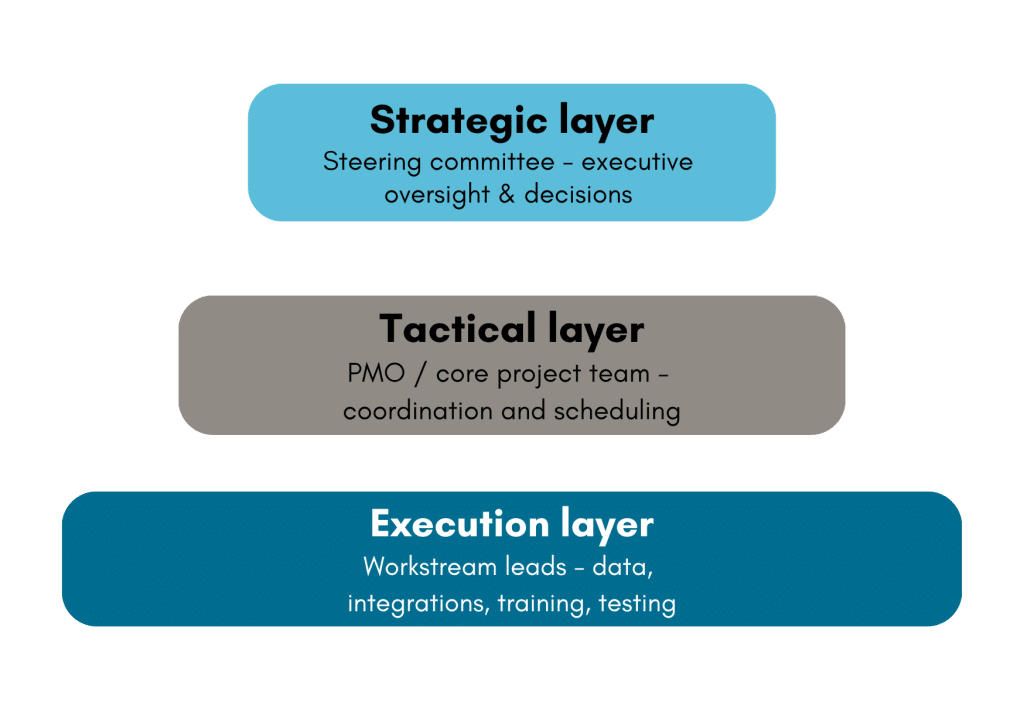
Layer 1: The Steering Committee
This is your executive sponsorship in action. Senior leaders from operations, IT, finance, and customer service—any function the WMS meaningfully touches. Their job isn’t day-to-day management. It’s strategic oversight: approving major decisions, allocating resources, and clearing organizational roadblocks the project team can’t clear on their own.
They should meet monthly, or at major milestones. Not weekly—that’s micromanagement. But regularly enough to stay engaged and make timely calls when issues get escalated.
What goes wrong: steering committees that exist on paper and never meet. They show up at kickoff, nod, and you don’t see them again until go-live is failing. By then, it’s too late.
The fix is simple: put the meetings on calendars at kickoff. Make attendance mandatory. If your executives won’t commit to that, you have a sponsorship problem—not a scheduling problem.
Layer 2: The PMO / Core Project Team
This is where work actually gets coordinated. The core team includes a project manager (ideally from the client side, not just the vendor), the vendor’s implementation lead, and representatives from IT, operations, and any other critical functions.
This group meets weekly—sometimes daily during critical phases. They own the schedule, manage dependencies, track deliverables, and escalate to the steering committee when something needs a decision above their pay grade. At minimum, one senior operational leader should be in this meeting every week.
I want to be direct about one thing: the project manager role cannot be a side assignment. I’ve watched projects fail because the PM was someone’s 20% job, competing with ten other priorities. You need someone who wakes up thinking about this implementation. If you can’t dedicate a strong PM full-time, you’re not ready to implement.
And if you want real accountability, tie it to measurable outcomes—not just hitting a date. Throughput, accuracy, labor efficiency. Build that into how people are evaluated.
Layer 3: Workstream Leads
These are the people responsible for specific areas of work: data migration, integrations, training, testing, change management. Each lead owns their workstream, coordinates with other leads on dependencies, and reports to the core team.
The key word is owns. Workstream leads need actual authority to make decisions within their domain—and dedicated time to do the work. If your data migration lead is also running daily warehouse operations, you already know which one gets their attention when the floor gets busy.
Why This Structure Works
The three-layer model creates clarity at every level. Strategic decisions go to the steering committee. Tactical coordination happens at the PMO. Execution lives with workstream leads. Everyone knows where they fit and who to escalate to.
When that’s working, implementations move. When it’s not, everything stalls—regardless of how capable the software is.
WMS governance isn’t a formality. It’s the foundation that makes everything else possible: accurate data migration, effective change management, on-time go-live, and a system your team actually uses after cutover.
Build the Team Before You Build the Plan
The most common mistake I see in WMS implementations isn’t choosing the wrong system. It’s underinvesting in the people and structure responsible for making it work.
Before you finalize a timeline, before you sign a contract, before you schedule a kickoff call—get your governance model right. Define the layers. Assign the roles. Get executive calendars blocked. That’s where successful implementations begin.
Thinking about a WMS implementation? Start with the team, not the technology. Reach out to Cornerstone Edge for practical guidance on building a governance structure that actually works.